Manufacturing · Material
Loofah Material: Fibre, Grades, Colour and Components
The material behind every product we make: where it grows, how it is processed and graded, how the colour is achieved, what it is sewn to, and what you can honestly say about it.

What loofah is
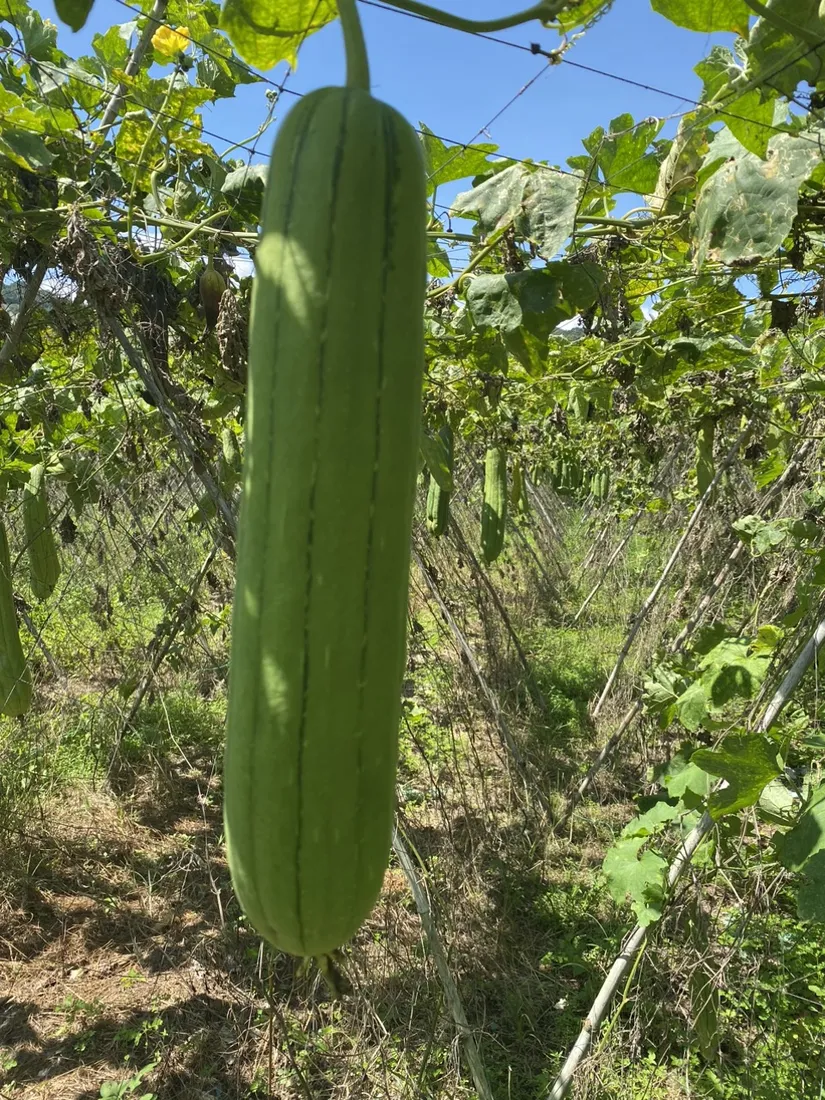
Loofah (also luffa) is the dried fibrous skeleton of a gourd from the Luffa genus, grown on vines. Picked young, the gourd is a vegetable; left to mature, the flesh dries away and leaves a network of tough fibres. That network, peeled, cleaned, dried, graded and cut, is the material in every product we make. How it is graded, what colour it is and what it is sewn to decide how the finished product performs and what you can say about it.
The fibre is plant cellulose arranged in a three-dimensional mesh. It is firm when dry and softens when wet, which is why a first-time user who touches a dry sample often expects it to be harsher than it is.
Density, thickness and colour vary from gourd to gourd. That variation is the material, not a defect, and it is the reason we grade fibre and approve every order against a physical sample.
In this guide
From vine to finished product
- Growing and harvest
Action: Loofah is grown by smallholders in Central Vietnam and harvested when the gourd has matured on the vine.
Result: Gourds with fully formed fibre, bought directly from growers at agreed prices. - Peeling and cleaning
Action: The skin is peeled by hand and seeds and residue are washed out.
Result: Clean fibre ready for drying. - Drying
Action: Fibre is dried until the meter reads 12% moisture or below.
Result: Stock that will not develop mould in a sealed carton.Note: Most quality problems with loofah start with moisture. This is the step we do not shortcut.
- Whitening, if specified
Action: Where a lighter colour is ordered, fibre is whitened with steam, not chlorine bleach.
Result: A lighter, even colour without chlorine bleach. - Grading, cutting and sewing
Action: Fibre is sorted by density, cut to the SKU pattern and sewn to backing, binding or handle.
Result: Finished pieces within the approved size and density range. - Inspection and packing
Action: Pieces are checked for size, colour, odour, mould and stitching, then packed.
Result: Cartons ready for export with a moisture record attached to the lot.
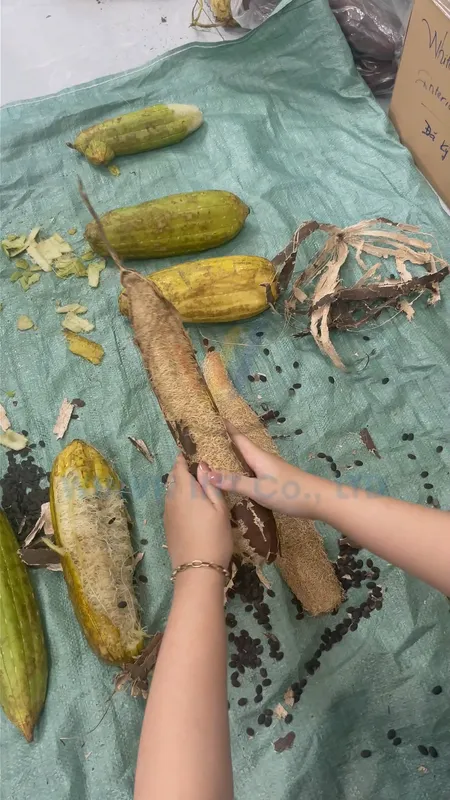
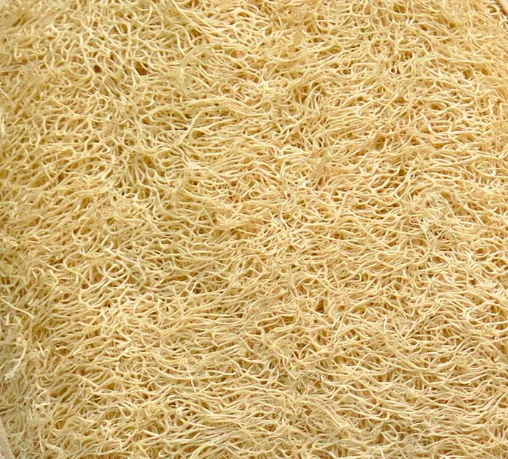
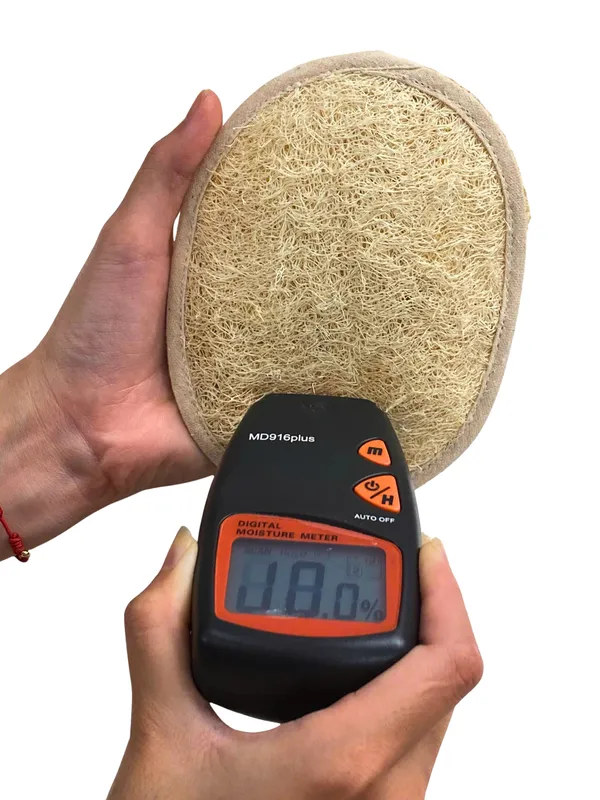
Our checks at each stage are on quality control and factory and production.
Properties buyers ask about
| Property | What to expect | What it does not mean |
|---|---|---|
| Texture | Firm when dry, noticeably softer when wet. | Not a measured abrasiveness rating; describe the feel, not a skin benefit. |
| Drying | The open mesh dries faster than closed-cell foam when hung in an airy place. | Not self-sanitising; it still needs rinsing and drying. |
| Colour | Natural beige to light brown; lighter if steam-whitened. | Colour is not a quality grade on its own. |
| Density | Varies by gourd; graded before cutting. | Two pieces of one SKU will not weigh exactly the same. |
| End of life | Plant fibre; non-fibre parts must be removed first. | Not a certified compostability claim for your market. |
Composition, whitening method and moisture are statements we can document. Environmental and skin-benefit claims are different: they need evidence for the finished product, the pack and the market you sell in.
Fibre grades and density
Loofah is graded by density (how tightly the fibres are packed), thickness, colour and the absence of defects such as spots, breaks and holes. There is no industry-wide grade standard, so a grade name on one supplier’s price list does not mean the same thing on another’s. The reliable specification is a physical sample you approve, plus a stated size tolerance.
- Density decides how firm the item feels and how long it holds its shape.
- Thickness decides how much fibre is in each piece and the pack size.
- Colour is agreed as a range on the sample, not as a single shade.
- Defects such as spots, breaks, holes and musty odour are removed at inspection.
Density by product
| Product | Fibre feel | Why that density |
|---|---|---|
| Loofah Bath Glove | Medium-firm | Firm enough to scrub, soft enough for daily use. |
| Oval Exfoliating Scrubber | Soft-medium | Compact pad; softer fibre suits a smaller surface. |
| Droplet Bath Sponge | Soft | Softest option for gentle cleansing. |
| Loofah Back Scrubber Belt | Firm | Firm fibre that holds its shape along a 70 cm strip. |
| Wooden Handle Back Scrubber | Firm | Firm head that keeps its form on a handle. |
| Wooden Handle Heel Scrubber | Firm | Firm head for heels and soles. |
| Teardrop Dishwashing Sponge | Dense | Dense fibre for scrubbing dishes. |
| Rectangular Dishwashing Sponge | Dense | Dense fibre for scrubbing dishes. |
How to specify fibre so the bulk order matches the sample
- Approve a sample per SKU
Action: Handle it dry and wet, measure it, and keep one piece as the retained reference.
Result: A physical standard, not a grade name. - State a size tolerance
Action: Write the size and the acceptable variation into the order.
Result: A measurable basis for accepting or rejecting a delivery. - Agree the colour range
Action: Photograph the acceptable lightest and darkest pieces against your sample.
Result: No argument later about what “natural colour” means. - List the rejectable defects
Action: Spots, breaks, holes, loose stitching, musty odour.
Result: Defects defined before production, not after arrival.
The most common way a bulk order drifts from the sample is thinner, looser fibre. Tie the price to a density you have actually held in your hand.
Natural colour and steam whitening
Untreated loofah is beige to light brown. Buyers who want a lighter, more even colour can order steam-whitened fibre: we whiten with steam, not chlorine bleach. Chemically bleached fibre is common in the market because it is cheaper and faster. The difference is not visible in a photograph, so ask every supplier how the colour was achieved.
| Finish | How it is made | Colour | What to check |
|---|---|---|---|
| Natural | Peeled, cleaned and dried; no whitening step. | Beige to light brown, varies by gourd. | Agree a colour range on the sample. |
| Steam-whitened | Whitened with steam after cleaning. | Lighter and more even. | Ask the supplier to state the method in writing. |
| Chemically bleached | Treated with bleaching agents. | Very white. | Not offered by us. Ask any supplier who offers it what was used and how it was rinsed. |
Supported by the method
- “Whitened with steam — no chlorine bleach used”, when the method is stated on your quotation.
- “Natural loofah fibre” for the fibre itself.
Not supported by the method alone
- “Safe for sensitive skin”, which needs testing on the finished product.
- “Chemical-free”: everything is made of chemicals, and regulators treat this phrase as misleading.
- “EU-approved”: there is no such approval for loofah.
- Decide the look
Action: Order a natural and a steam-whitened sample side by side.
Result: A colour choice made in hand, not on screen. - Match it to the channel
Action: Natural often suits zero-waste shops; lighter fibre often suits hotel and gift sets.
Result: A finish that fits the story on the shelf. - Put the method in writing
Action: Ask for the whitening method on the quotation and the invoice.
Result: A document behind the words on your pack.
Colour also changes with storage. Loofah kept damp or in sunlight can darken or spot, which is another reason moisture is checked with a meter before packing and cartons are sealed.
Components and plastic-free packs
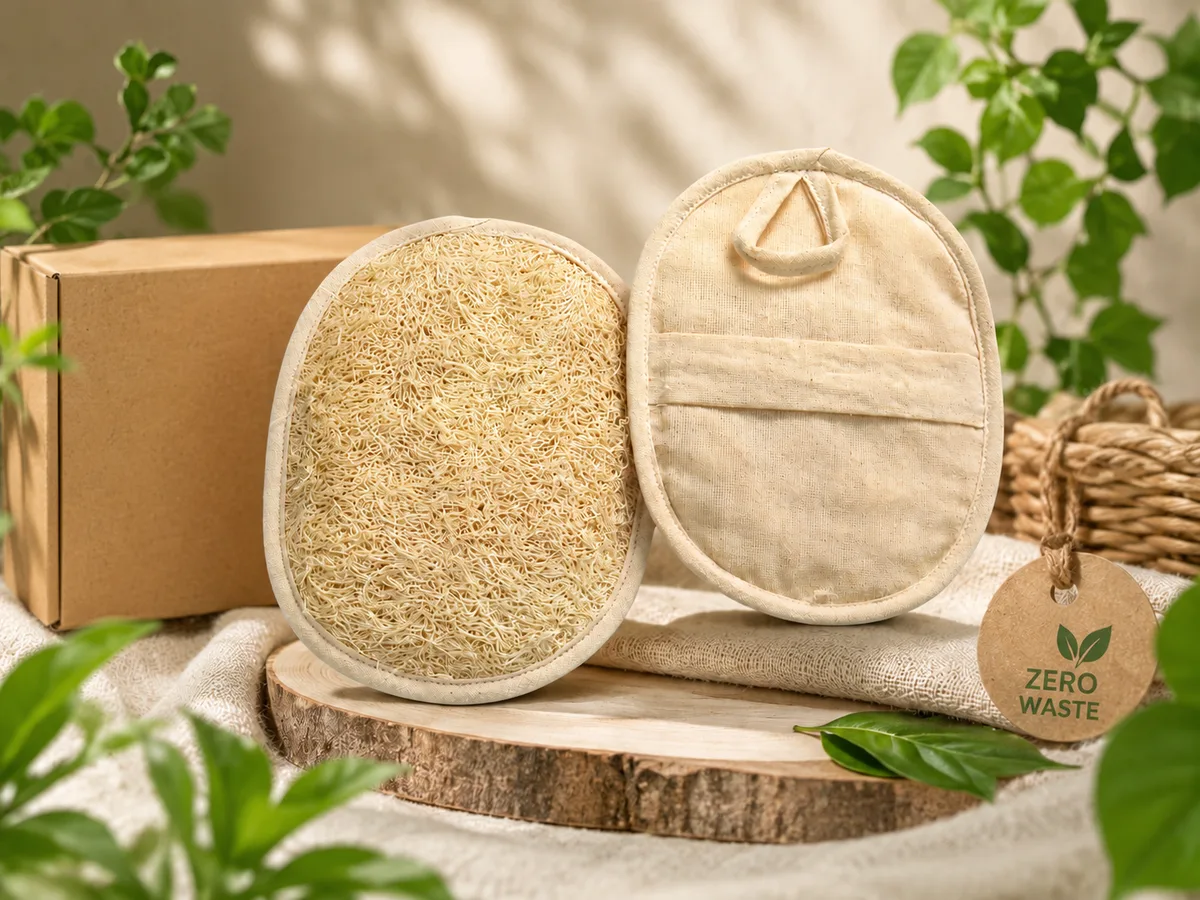
The loofah fibre is a plant material. Whether the finished product is plastic-free depends on every other component (backing, binding, strap, cord, thread, label) and on the pack. The kitchen sponges come closest to single-material. Each bath item has at least one other component. List them before you print a plastic-free or single-material claim.
| Product | Main material | Other components | Confirm before claiming |
|---|---|---|---|
| Loofah Bath Glove | Loofah fibre | Fabric backing | Sewn edge; cuff |
| Oval Exfoliating Scrubber | Loofah fibre | Fabric backing; elastic hand strap | Strap material — ask if a plastic-free brief |
| Droplet Bath Sponge | Loofah fibre | Fabric backing and binding; hanging loop | Binding and loop materials |
| Loofah Back Scrubber Belt | Loofah fibre | Fabric backing and binding; two hand straps | Strap and binding materials |
| Wooden Handle Back Scrubber | Loofah fibre head | Wooden handle; hanging cord | Handle finish; cord material |
| Wooden Handle Heel Scrubber | Loofah fibre head | Wooden handle; hanging cord | Handle finish; cord material |
| Teardrop Dishwashing Sponge | Loofah fibre | Hanging cord | Cord material |
| Rectangular Dishwashing Sponge | Loofah fibre | Hanging cord | Cord material |
Specifying a plastic-free pack
| Pack element | Plastic-free option | Watch out for |
|---|---|---|
| Outer bag | Paper bag or no bag inside a carton | Protection from moisture on a long sea voyage. |
| Retail pack | Kraft paper band, sleeve or box | Laminated or window boxes add plastic. |
| Label / hang tag | Paper tag with cotton or jute string | Plastic tag fasteners. |
| Barcode | Printed on paper | Adhesive plastic labels. |
| Desiccant | Specify the type in writing if your market restricts it | Plastic sachet film. |
A plastic-free pack is possible, but it is a specification, not a default. Approve it on a sample with your artwork, and keep the component list on file.
Usually supportable
- “Made with natural loofah fibre”.
- “Plastic-free sponge”, for a kitchen sponge where the cord is natural fibre and confirmed in writing.
- “Remove the cord / handle before composting the fibre”.
Needs more than the fibre
- “100% natural” on an item with a synthetic strap or binding.
- “Biodegradable” or “compostable” without evidence for the finished product in your market.
- “Zero waste” as a product claim rather than a shop category.
For the wider picture, see which environmental claims you can make for loofah products, whether loofah is compostable and our sustainability approach.
Questions to ask any supplier about the material
- Where is the fibre grown, and do you buy directly from growers?
- What happens to fibre that fails your density grade: is it used in another product or discarded?
- Can I see the lightest and darkest pieces you would ship against my sample?
- How is the colour achieved: natural, steam or chemical bleach? Please state it on the quotation.
- Which defects are removed at inspection, and is that piece by piece or by sampling?
- What moisture reading is the fibre packed at, and how is it measured?
- What is every non-fibre component made of, in writing?
Our answers are on quality control. For a buyer-level overview of the material, uses and market, read the complete guide to natural loofah.
Buyer questions
Is loofah a sea sponge?
No. Loofah is a plant: the dried fibre of a gourd grown on vines. Sea sponges are animals.
Where is your loofah grown?
By smallholders in Central Vietnam. We buy directly from growers and process the fibre in our own factories.
Why does the colour vary between pieces?
Because each gourd is different. We agree an acceptable colour range on your sample, and remove spotted or discoloured pieces at inspection.
Is a denser loofah always better?
No. Denser fibre is firmer and suits dish sponges and brushes; a softer fibre suits a gentle bath sponge. Choose the density for the use.
Why is my sample heavier than another supplier’s?
Usually more or denser fibre per piece. Compare weight together with size and feel, not price alone.
Is steam-whitened loofah more expensive?
Usually slightly, because it is an extra processing step and takes longer than chemical bleaching. The quote shows it as part of the SKU price.
Can I order natural colour only?
Yes. Natural fibre is supplied without a whitening step; agree the colour range on your sample.
Which product is closest to single-material?
The two kitchen sponges: loofah fibre plus a hanging cord. Confirm the cord material in writing if you need a single-material claim.
Can you ship without any plastic bag?
Yes, on request, but consider moisture protection on a long sea voyage. Agree the pack on a sample.