Care
Are Loofahs Hygienic? How a Natural Loofah Should Be Dried, Used and Replaced
The short answer
A loofah is hygienic if it dries out completely between uses, is cleaned regularly and is replaced on time. The risk is real: a 1994 study in the Journal of Clinical Microbiology found that wet loofahs can grow bacteria including Pseudomonas, and Cleveland Clinic advises replacing a natural loofah every 3–4 weeks. The fibre is not the problem. Constant moisture plus trapped skin cells is.
Hygiene is the first objection buyers raise about loofah, and it usually comes from a dermatologist quote they read online. The quote is generally accurate. What it leaves out is that most of the risk is controllable, partly by the customer and partly by the manufacturer. This guide covers both sides, including moisture readings from our own production.
Why loofahs can hold bacteria
A loofah is a dense web of plant fibre with many small cavities. In the shower, those cavities fill with water, soap and the dead skin the loofah has just removed. If the loofah then hangs in a steamy bathroom, it never fully dries. Warm, wet, and supplied with organic matter is the combination bacteria need.
Cleveland Clinic dermatologist Dr. Melissa Piliang describes it plainly: loofahs are used in a wet environment and hung in a wet environment, so they do not dry out, which makes them a good place for bacteria to grow. Cleveland Clinic lists E. coli, Pseudomonas aeruginosa, Staphylococcus and Streptococcus as organisms of concern, along with fungi.
What the research found
The study most often cited is Bottone and colleagues, "Loofah sponges as reservoirs and vehicles in the transmission of potentially pathogenic bacterial species to human skin", Journal of Clinical Microbiology, February 1994. It started with a patient case: a skin infection (Pseudomonas folliculitis) traced back to a contaminated loofah.
The researchers then tested loofah pieces and found they supported gram-negative bacteria such as Pseudomonas, Xanthomonas and Klebsiella, and gram-positive species including Enterococcus and group B Streptococcus. Two details are useful for anyone selling the product:
- New, unused loofahs started with sparse, mostly harmless flora. Once hydrated, the flora shifted toward gram-negative bacteria. In other words, keeping the loofah wet changed what grew on it.
- Growth increased when dead skin cells built up in the fibre. Rinsing matters, not just drying.
The authors recommended decontaminating loofahs with diluted hypochlorite bleach at regular intervals. That study is more than thirty years old and was a lab and case investigation, not a population study. It is still the best-known evidence, and it is consistent with current clinical advice.
Hygiene starts before the loofah reaches the shower
Customers can only control what happens after they open the package. What happens before is the manufacturer's job, and the main risk is moisture. Loofah packed while damp can arrive with a sour smell or dark spots after weeks in a sea container, before anyone has used it.
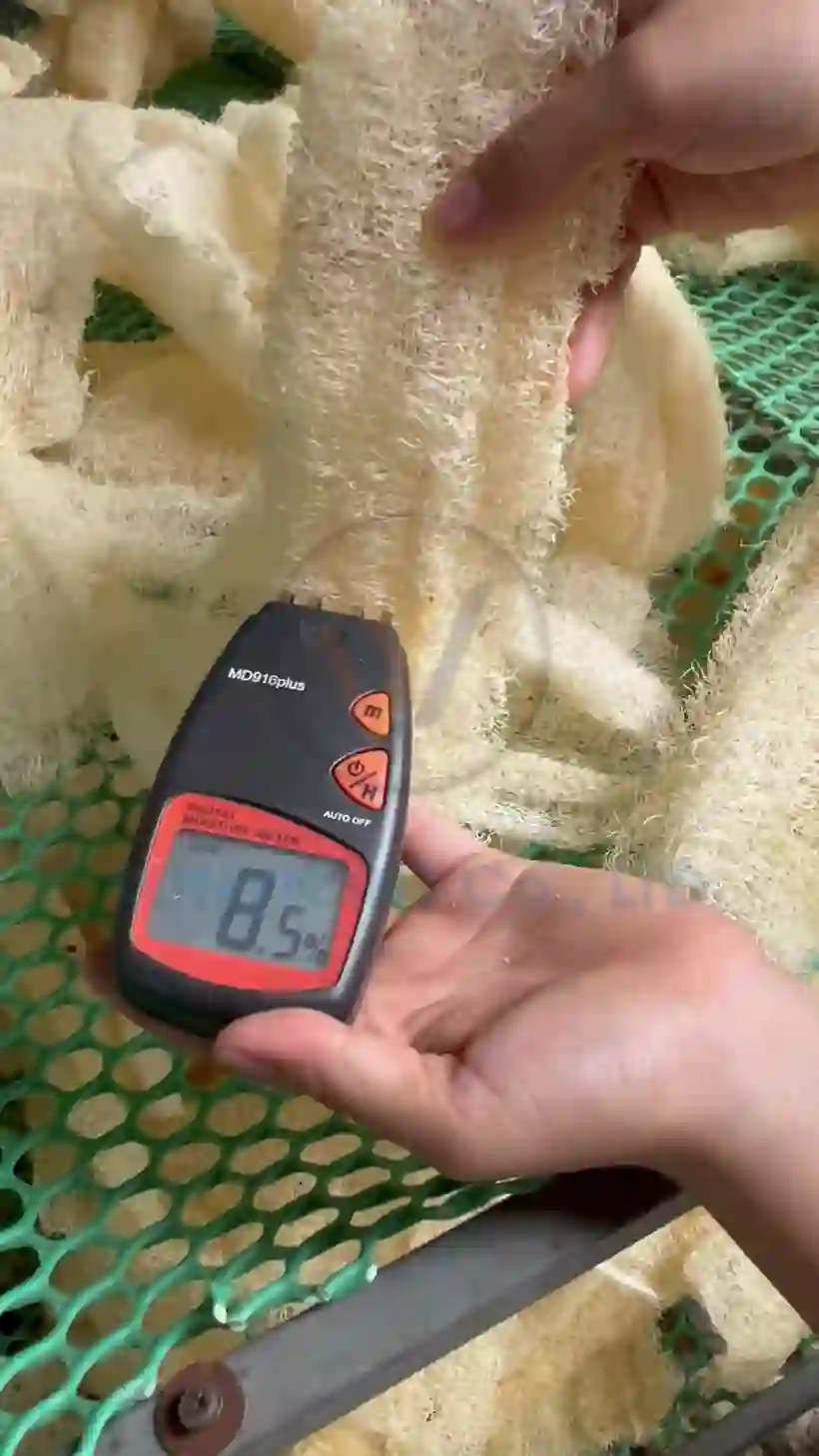
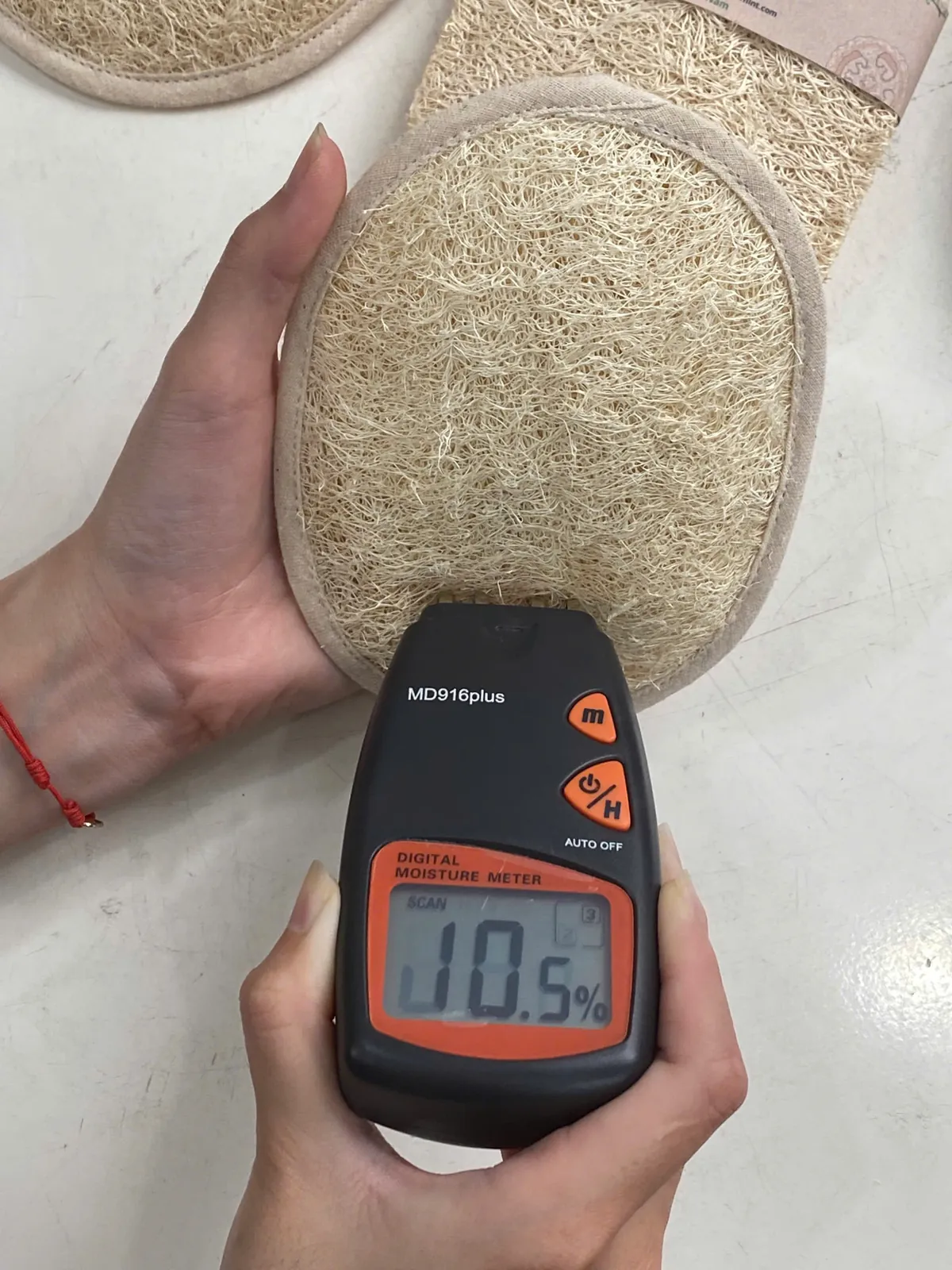
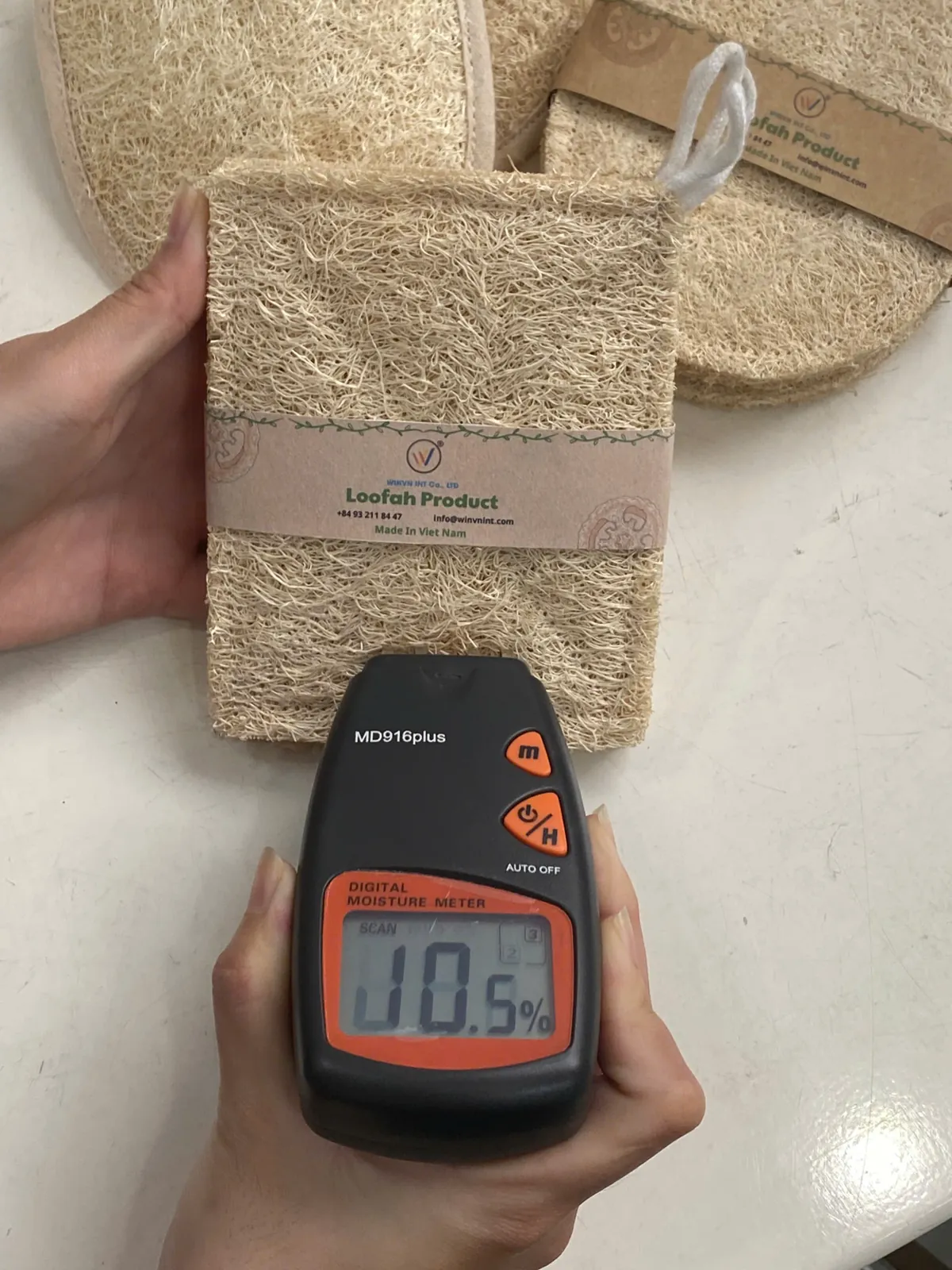
Our limit is 12% moisture or below at packing. Every batch is checked with a handheld MD916plus digital moisture meter. Here are eleven readings from one recent check, taken on finished teardrop, oval and rectangular pieces just before packing:
| # | Product shape | Reading | Within 12% limit |
|---|---|---|---|
| 1 | Teardrop dish sponge | 10.0% | Yes |
| 2 | Teardrop dish sponge | 10.0% | Yes |
| 3 | Oval exfoliating pad | 10.5% | Yes |
| 4 | Oval exfoliating pad | 10.0% | Yes |
| 5 | Oval exfoliating pad | 10.5% | Yes |
| 6 | Rectangular dish sponge | 10.5% | Yes |
| 7 | Teardrop dish sponge | 9.5% | Yes |
| 8 | Teardrop dish sponge | 10.0% | Yes |
| 9 | Rectangular dish sponge | 10.0% | Yes |
| 10 | Rectangular dish sponge | 10.0% | Yes |
| 11 | Teardrop dish sponge | 9.5% | Yes |
The readings ran from 9.5% to 10.5%, with an average of 10.05%. One caution on method: handheld meters of this kind are built mainly for wood and building materials, so we treat the number as a screening check against our limit rather than a laboratory measurement. A piece that reads high is set aside and dried again. If you need a lab moisture test for a specific order, we can arrange one.
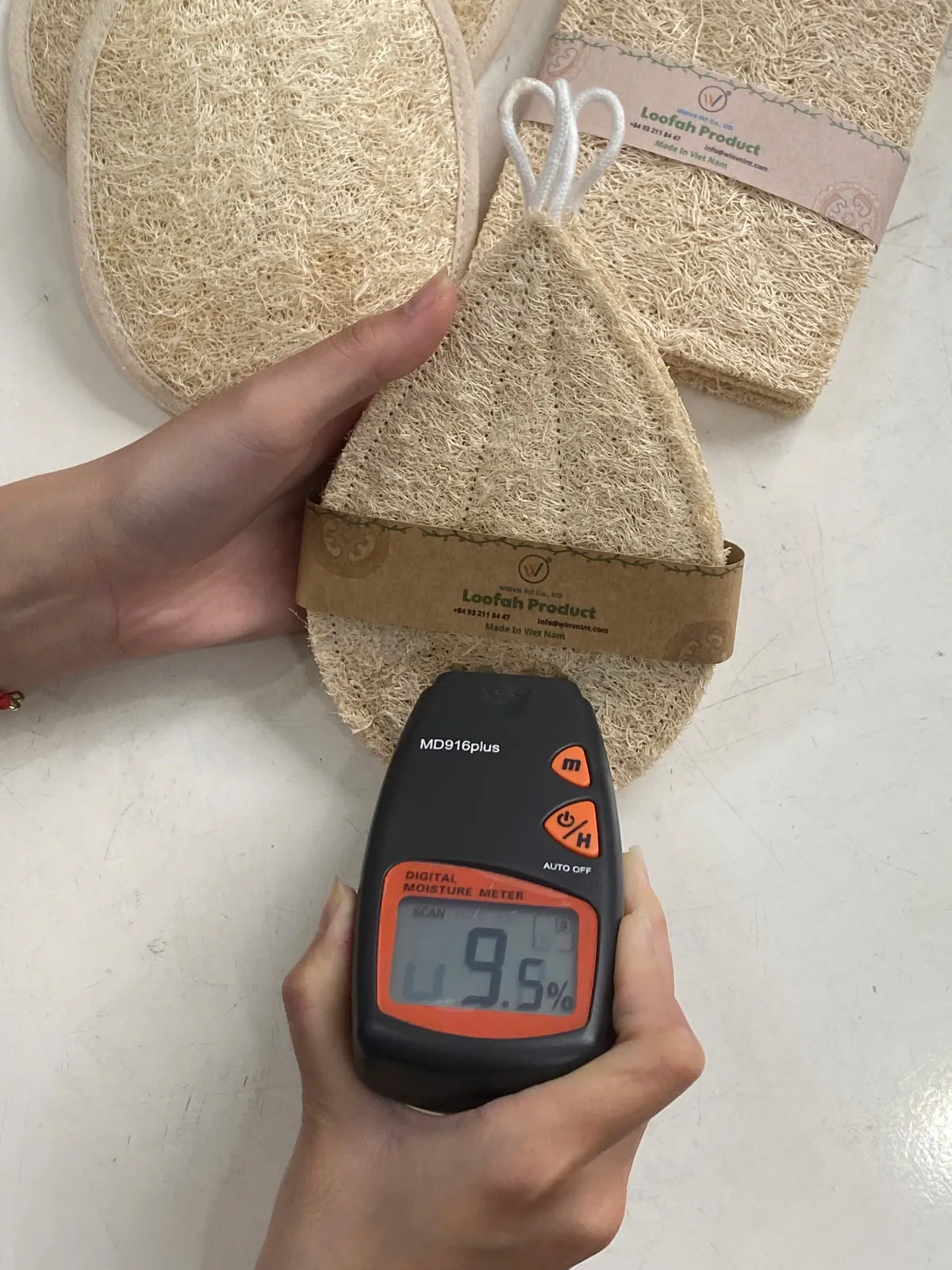
Two other production steps affect hygiene. We whiten with steam only, no chlorine, and every batch is visually checked for mould before packing. You can read more on the quality and process page.
How to dry a loofah after each use
Drying is the single habit that changes the outcome most. These steps are what we print on our care cards.
- Rinse out the soap. Hold the loofah under running water and squeeze it several times. Done when: the water runs clear and no lather comes out.
- Squeeze out the water. Press it flat between your palms; do not wring and twist a flat pad. Done when: it stops dripping.
- Shake it. A few hard shakes clear water from the inner cavities. Done when: it feels damp, not wet.
- Hang it outside the shower. Use the loop on a hook where air moves, ideally outside the bathroom or by an open window. Done when: it is dry and stiff to the touch before the next use.
Note: do not leave a loofah in a shower caddy or on a soap dish where water collects under it. That is the setup most likely to produce a smell within a week.
How to clean and sanitize a loofah
Cleveland Clinic suggests a weekly clean, and the 1994 study authors recommended periodic bleach decontamination. Either of these methods works for loofah that has no metal or wooden parts.
- Diluted bleach soak, weekly. Soak the loofah for about five minutes in a diluted household bleach solution, following the bleach label for dilution, then rinse thoroughly and dry. Done when: no bleach smell remains after rinsing.
- Dishwasher, as an alternative. Place it on the top rack of a normal cycle. Done when: it comes out clean; dry it fully before use.
Note: we do not recommend microwaving a loofah. Advice to do this circulates online, but dry plant fibre can scorch, and pieces with wooden handles should never go in a microwave.
When to replace a loofah
| Use | Replace | Replace immediately if |
|---|---|---|
| Body (bath, shower) | Every 3–4 weeks (Cleveland Clinic) | Visible mould, dark spots, or a musty smell that stays after drying |
| Kitchen (dishes) | When fibres start breaking or it stops springing back | A smell that stays after it has dried fully |
| Hotel or spa guest use | One guest, one piece | Any sign of previous use |
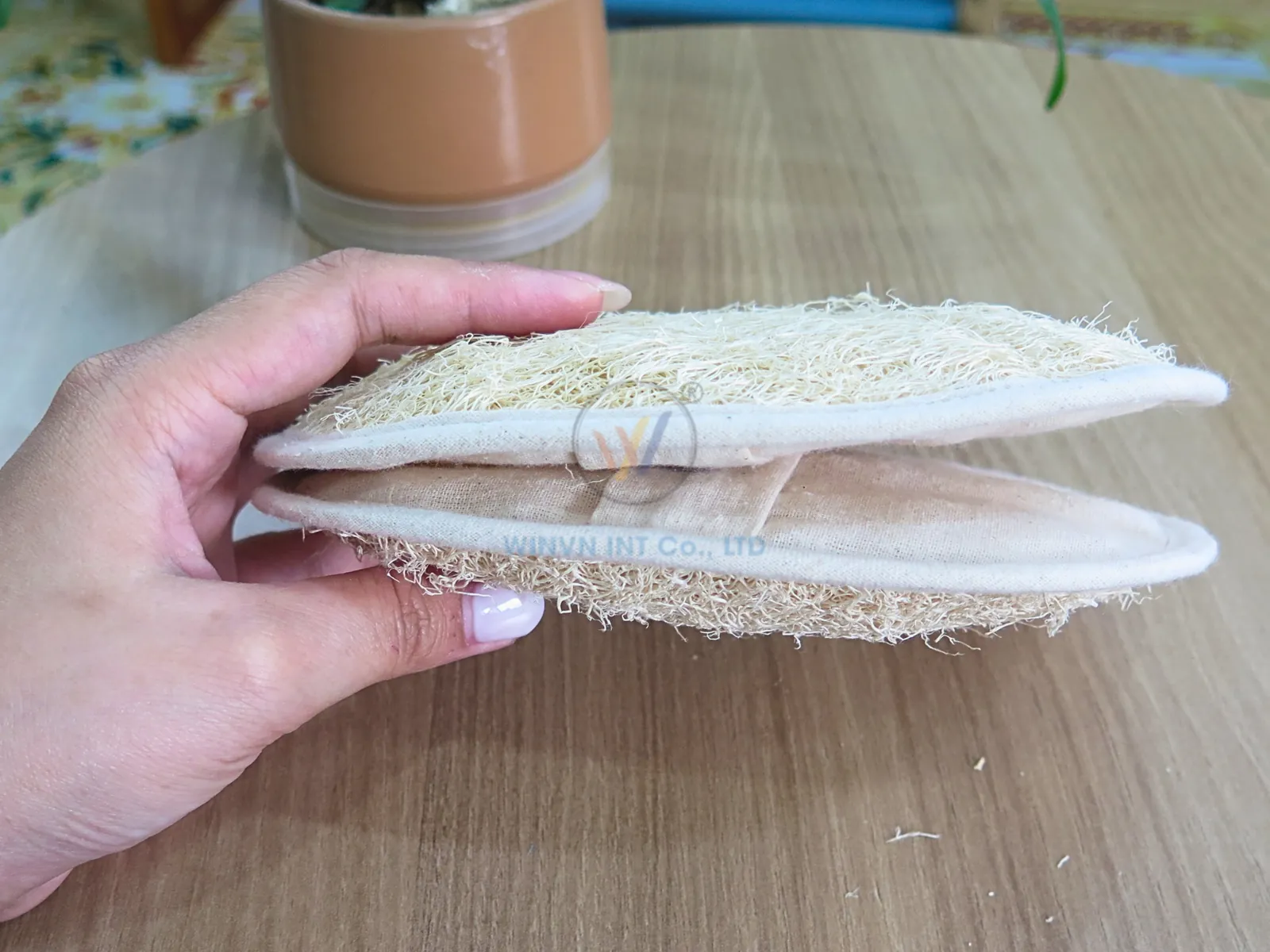
A used bath loofah can move to cleaning jobs such as sinks and garden pots before it is thrown away. For disposal, see how to compost a loofah.
Loofah, silicone or washcloth: which is more hygienic?
Silicone brands often market their scrubbers against loofah on hygiene, and they have a point. Silicone is non-porous, so it does not trap skin cells the way fibre does. The trade-off is material: silicone is a synthetic polymer and will not compost.
| Natural loofah | Silicone scrubber | Cotton washcloth | |
|---|---|---|---|
| Traps skin cells | Yes, in the fibre | Little, non-porous surface | Yes, in the weave |
| Dries between uses | Fast if hung in air | Fast | Slow |
| Easy to sanitize | Bleach soak or dishwasher | Hot water, dishwasher | Hot laundry wash |
| Replacement | 3–4 weeks | Long-lasting | Wash after each use |
| Exfoliation | Strong | Mild | Mild |
| End of life | Plant fibre; remove non-fibre parts first | Not compostable | Textile waste or compost if 100% cotton |
Loofah is a good choice if
- You want real exfoliation and no plastic
- You will hang it to dry and replace it monthly
- You use it on the body, not the face
Choose something else if
- You have eczema, broken skin or have just shaved
- Your bathroom has no place for it to dry
- You will share it with other people
A care card retailers can print
Many negative reviews about smell come from customers who were never told how to dry a loofah. A small insert card fixes most of that. You are welcome to use this text on your own packaging:
Caring for your natural loofah. Soak before first use; it softens in water. After each use, rinse out all soap, squeeze, shake and hang it outside the shower to dry. Once a week, soak for 5 minutes in diluted bleach, rinse well, or run it through the dishwasher. Replace it when the fibre starts to break up, stays damp or smells musty. Do not use on the face or broken skin. Remove any cord or backing before disposing of the fibre.
If you are building a private label bath range and want this printed on your inserts, ask for a sample kit and we will include a card mockup. Relevant products: loofah bath glove, oval exfoliating scrubber and droplet bath sponge. For the material itself, see the natural loofah guide.
Sources
- Bottone et al., Loofah sponges as reservoirs and vehicles…, J Clin Microbiol 1994 (PubMed)
- Cleveland Clinic – Why loofahs can be bad and alternatives to try
Frequently asked
Are loofahs full of bacteria?
They can be if they stay wet. A 1994 study found wet loofahs supported bacteria including Pseudomonas and Klebsiella, and growth increased as dead skin built up. Drying fully between uses is the most important habit.
How often should you replace a natural loofah?
Cleveland Clinic advises every 3 to 4 weeks for a natural loofah used on the body, and immediately if you see mould or notice a musty smell.
How do you sanitize a loofah?
Once a week, soak it for about five minutes in diluted household bleach and rinse well, or run it through a dishwasher on the top rack. Let it dry fully before using it again.
Why does my loofah smell?
A smell usually means it is not drying between uses. Rinse out the soap, squeeze, shake and hang it outside the shower. If the smell stays after it has dried, replace it.
Can I use a loofah on my face?
It is not recommended. Cleveland Clinic advises against using loofahs on the face, on the genital area or on freshly shaved skin.
Is silicone more hygienic than loofah?
Silicone is non-porous and easier to keep clean, but it is a synthetic polymer and cannot be composted. Loofah exfoliates more strongly and is plastic-free, but it must be dried and replaced regularly.
What moisture level should dried loofah have?
We pack at 12 percent moisture or below. Readings from one recent check of finished pieces ranged from 9.5 to 10.5 percent.
Written from our own production and export experience. General information, not legal or compliance advice; confirm requirements for your market with your own advisor.